
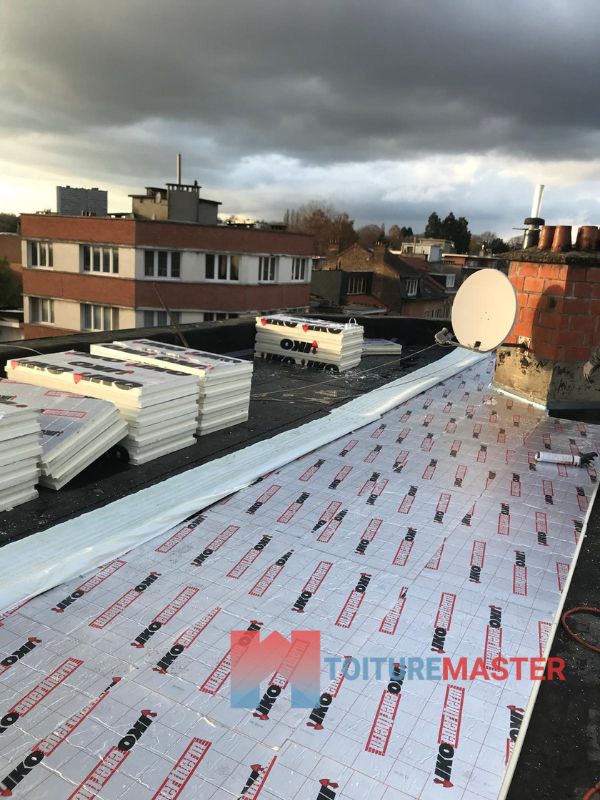

Roof insulation in Brussels typically costs between €20 and €115 per m² installed, depending on the method and material. The Brussels RENOLUTION grant scheme is currently under reform — no new applications can be submitted for invoices dated 2025 or 2026 until a new government decision is published. A professional roofer like Toiture Master can advise you on the right material, correct installation method, and exactly when to apply for grants once the programme reopens.
Introduction
Roof insulation in Brussels is one of the best-value home improvements you can make in 2026. Energuide — Brussels Region’s official energy information service — confirms that a properly insulated roof can cut your heating costs by at least 30%, with the investment typically recovered within two to five years.
Here’s the number most Brussels homeowners don’t know: up to 30% of the heat in your home escapes through the roof.
Not through the windows. Not through the front door. Through the roof — and if your home was built before the 1980s, there’s a good chance it’s happening to you right now. Older terraced houses in Koekelberg, Molenbeek, Schaerbeek, and Anderlecht were built in an era when heating was cheap and insulation wasn’t a priority. That era is over. Energy isn’t cheap anymore, and the cost of an under-insulated roof shows up on your bill every single month.
This guide covers everything you need to make a smart decision: the real costs per m², the honest status of RENOLUTION grants in 2026, which insulation material is right for your roof type, and exactly how Toiture Master handles roof insulation in Brussels — including the free site visit they offer to every homeowner before a single quote is written.
Table of Contents
- Why Roof Insulation in Brussels Matters More Than You Think
- How Much Does Roof Insulation Cost in Brussels in 2026?
- Internal vs External Insulation: Which Is Right for Your Roof?
- The Best Insulation Materials for Brussels Roofs Explained
- RENOLUTION Grants in Brussels: The Honest 2026 Update
- The 6% VAT Reduction: The Grant You Can Still Use Right Now
- How Toiture Master Handles Roof Insulation in Brussels
- Signs Your Brussels Roof Is Poorly Insulated
- Your 2026 Roof Insulation Checklist
- FAQ: Roof Insulation in Brussels Answered
Why Roof Insulation in Brussels Matters More Than You Think
Here’s a number that surprises most Brussels homeowners: up to 30% of the heat in a typical semi-detached home escapes through the roof.
Not through gaps in windows. Not through draughty doors. Through the roof — the largest single surface of your home’s thermal envelope, and the one most often left uninsulated or underinsulated.
In Brussels, this problem is more common than you’d expect. The city’s housing stock is old. Many of the terraced homes in Koekelberg, Molenbeek, Anderlecht, and Schaerbeek were built in the early 20th century — long before thermal performance was a building requirement. These homes were designed to be heated continuously, not insulated efficiently.
For modern homeowners, that legacy is expensive. A poorly insulated roof in a Brussels terraced house can add hundreds of euros to your annual energy bill. And with energy prices still volatile across Belgium in 2026, that’s not a theoretical problem — it’s a monthly one.
The good news? Roof insulation is one of the highest-return home improvement investments you can make. Energuide — Brussels Region’s official energy information service — confirms that a well-insulated roof can reduce your heating bill by at least 30%, with the typical investment recouped within two to five years. That’s not just comfort. That’s a return on investment most financial products can’t match.
And if you’re thinking about selling your property, a good EPC (energy performance certificate) rating is increasingly important. From 2033, Brussels law requires all residential properties to reach at least label D. Roof insulation is typically the single most impactful step to moving up the energy label scale — more effective per euro than new windows, and often cheaper than replacing a heating system.
So if you’ve been putting off roof insulation because it feels complicated or expensive, this guide is for you. We’ll walk you through the real costs, the material choices, the honest 2026 grant situation, and exactly what happens when Toiture Master insulates a Brussels roof.
How Much Does Roof Insulation Cost in Brussels in 2026?
Let’s start with the question every Brussels homeowner wants answered first: what does it actually cost?
The honest answer is that it depends on three things — the size of your roof, the insulation method you choose, and the material used. But here are real, usable figures.
Internal insulation (between the rafters):
This is the most accessible option for most Brussels homeowners. The insulation material — glass wool, rock wool, or PIR boards — is fitted between the existing roof structure from inside the loft or attic. You don’t touch the exterior roof covering.
Expect to pay between €20 and €50 per m² installed, depending on material. For a typical Brussels terraced house with a roof area of 60–80 m², that puts the total project at roughly €1,200 to €4,000.
External insulation — sarking:
Sarking is where a continuous layer of rigid insulation board is installed on top of the existing roof structure, under a new roof covering. It requires removing and relaying the tiles or slates, which adds cost but delivers significantly better thermal performance with no cold bridges.
External insulation typically costs between €75 and €150 per m² when combined with a roof covering replacement. For a 70 m² roof, that’s €5,250 to €10,500 — but since you’re replacing the roof covering at the same time, the pure insulation cost is effectively shared with the renovation project.
Flat roof insulation:
Flat roofs are common across Brussels — particularly in 1960s–1980s buildings and modern extensions in Etterbeek, Ixelles, and Forest. Flat roof insulation uses pressure-resistant rigid materials (PIR, EPS, or XPS) installed above the structural deck.
Expect to pay between €30 and €90 per m² depending on method and material thickness.
Total project cost benchmarks:
KBC Brussels Bank puts the typical full roof insulation project budget between €5,000 and €12,500 for a standard Brussels home. These figures are pre-grant, pre-VAT reduction. After the 6% VAT rate is applied and once grants reopen, the net cost for eligible households can be considerably lower.
Internal vs External Insulation: Which Is Right for Your Roof?
This is the question Toiture Master gets asked on almost every roof insulation site visit in Brussels. There’s no single right answer — it depends on your roof’s condition, your budget, and your future plans.
The case for internal insulation:
Internal insulation — also called between-rafter or warm roof insulation — is the most widely used method across Brussels. The insulation material is fitted between the structural rafters from inside the loft. It’s the lower-cost option, and it doesn’t require touching the exterior roof covering.
For Brussels homes where tiles or slates are in good condition and have years of life left, disturbing the exterior is unnecessary. Internal insulation makes sound economic sense.
The one limitation is thermal bridging. Timber rafters conduct heat — so even with excellent insulation between them, the rafters themselves create cold spots. This can be partly resolved by adding a second layer of insulation across the face of the rafters, but that reduces loft headroom.
Brussels building regulations specify a maximum heat transmission coefficient (U-value) of 0.3 W/m²K for roof insulation — roughly equivalent to 15cm of glass wool. Internal insulation can meet this standard, but only when installed without compression, without gaps, and with a proper vapour barrier fitted on the warm side.
The case for external insulation (sarking):
Sarking is the gold standard. A continuous rigid PIR insulation board is laid across the entire roof surface — on top of the rafters, under the new roof covering. Because the insulation is unbroken by any structural element, thermal bridges are eliminated and the entire roof performs uniformly.
The process: the old tiles or slates come off, a vapour barrier goes on, rigid boards are fixed to the roof structure with long screws, a vapour-open underlay membrane goes over the top, then counter-battens and new tiles or slates are installed over everything. It’s one combined operation.
It costs more. But you’re combining a full roof renovation with high-performance insulation in a single project — significantly more cost-effective than doing them separately at different times. If your tiles are more than 20–25 years old and replacement is on the horizon anyway, the timing often aligns perfectly for sarking.
For Brussels homes in Koekelberg, Laeken, and Jette — where much of the housing stock has ageing fibre-cement or clay tile roofs — sarking during a planned tile replacement is the most economical route to a properly insulated home.
For flat roofs:
Flat roofs need pressure-resistant insulation above the structural deck, below the waterproofing membrane — a « warm flat roof » configuration. PIR and EPS boards are the standard for Brussels flat roofs. The insulation must handle foot traffic during maintenance without compressing or deforming.
The Best Insulation Materials for Brussels Roofs Explained
Walk into any Belgian builders’ merchant and you’ll find dozens of insulation products with different lambda values, R-values, and fire ratings. Here’s a plain-language guide to the four materials Toiture Master works with most often.
Glass wool (laine de verre)
Glass wool is one of Belgium’s most widely used insulation materials. It’s flexible, lightweight, and relatively affordable. For internal roof insulation between rafters, it fits naturally — easy to cut, slightly compressible to fit irregular rafter spacings, and providing solid thermal performance.
Material cost: around €10–€20 per m². Installed: €20–€35 per m².
The important caveat is moisture. Glass wool absorbs water if it gets wet, which significantly reduces its insulating performance. A proper vapour barrier on the warm side is non-negotiable. Without it, glass wool in a Brussels roof can cause far more problems than it solves.
Rock wool / stone wool (laine de roche)
Rock wool is denser than glass wool, more fire-resistant, and offers better acoustic insulation — genuinely useful in Brussels, where urban noise is a real quality-of-life issue. Made from volcanic basalt, it performs well in humid environments and regulates moisture more naturally than glass wool.
Material cost: around €20 per m². Installed: approximately €35 per m².
For Brussels homeowners who want a quieter as well as a warmer home, rock wool is worth the modest price premium. Isover — Toiture Master’s preferred insulation supplier — produces both glass wool and rock wool products that meet Belgian EPB technical requirements.
PIR boards (polyisocyanurate)
PIR is the highest-performing rigid insulation board widely used in Belgium. Its thermal conductivity (lambda value) is around 0.022 W/mK — roughly twice the insulating performance per centimetre compared to glass wool. You achieve the same thermal resistance at half the thickness.
Material cost: €12–€30 per m². Installed as sarking: €40–€60 per m² (excluding roof covering replacement).
PIR is the material of choice for external sarking insulation and flat roof systems. It’s moisture-resistant, dimensionally stable, lightweight, and available in thicknesses from 40mm to 200mm. For Brussels homeowners combining a full tile replacement with insulation, or renovating a flat roof, PIR is almost always the right call.
PUR foam (polyurethane spray foam)
PUR spray foam fills cavities and irregular spaces that rigid boards can’t reach — loft hatches, pipe penetrations, awkward angles in complex roof geometry. It shouldn’t be the primary insulation method for a pitched roof, but as a complement to PIR or mineral wool, it seals thermal bridges effectively.
It’s not a DIY product. Professional equipment and the right formulation are required. Toiture Master uses PUR foam selectively, as a targeted complement to other materials, never as a standalone solution.
RENOLUTION Grants in Brussels: The Honest 2026 Update
Let’s be completely straight with you here, because a lot of websites are still publishing outdated or misleading information about Brussels renovation grants.
The current situation as of May 2026:
The Brussels-Capital Region’s RENOLUTION grant scheme is in a period of suspension. The official Brussels government website confirms that no government decision has been made regarding RENOLUTION grants for invoices dated 2025 or 2026. This means no grant applications can currently be submitted for work completed in 2025 or 2026.
This is the direct result of the prolonged government formation process following the June 2024 regional elections. Without a sitting government, no budget decisions on the grant programme have been made.
What RENOLUTION offered — and will likely offer again:
For context: RENOLUTION launched in January 2022, merging all previous Brussels energy and renovation grants into one scheme of 45 individual grants. For roof insulation specifically, the previous structure was:
- Lower income (Category I): up to €40 per m² for thermal insulatio
- Middle income (Category II): around €20–€30 per m
- Higher income (Category III): lower base amounts
For roof covering and waterproofing, additional separate grants of up to €80 per m² were available.
These are 2024 figures — the last year the scheme was fully operational. Whether future grants will match, exceed, or fall below these amounts depends entirely on the new government’s budget decisions.
What to do right now:
Don’t wait indefinitely for grants that may not arrive on your timetable. Your roof’s performance needs exist regardless of the grant situation. The practical approach: get your insulation done now, retain all invoices and documentation carefully, and apply for grants as soon as the programme reopens for your invoice date.
For current grant status, check directly at renolution brussels — the only source you should trust for live information. Toiture Master will ensure your project meets the technical conditions — minimum R-value of 4.5 m²K/W for roof insulation, certified materials, registered contractor — so you’re grant-ready the moment applications reopen.
The 6% VAT Reduction: The Grant You Can Still Use Right Now
While RENOLUTION grants are on hold, there’s a significant financial benefit available to you right now that doesn’t depend on Brussels government budget decisions.
The reduced 6% VAT rate on renovation work.
In Belgium, renovation work on homes over 10 years old qualifies for a reduced VAT rate of 6% instead of the standard 21%. That’s a 15-percentage-point difference on your invoice.
On a €8,000 roof insulation project, that’s €1,200 saved compared to the standard rate. On a €12,000 project, it’s €1,800. Real money, available now.
The conditions are simple:
- Your home must be at least 10 years old (virtually all Brussels housing stock qualifies)
- Work must be carried out by a professional contractor registered with the Belgian BCE — which Toiture Master is
- The invoice must be addressed to the person making the claim
- The property must be used primarily as a private dwelling
This isn’t a separate application. It’s the correct VAT rate that a qualified contractor automatically applies to your invoice. Toiture Master’s quotes reflect this rate for all qualifying properties.
Combined with the value of a properly insulated roof — lower energy bills from the first winter after installation — the 6% VAT saving makes starting now significantly more financially attractive than waiting for grants that may or may not materialise on a predictable timeline.
How Toiture Master Handles Roof Insulation in Brussels
Toiture Master insulates roofs across all 19 Brussels communes from their base in Koekelberg — from Uccle and Watermael-Boitsfort in the south, to Laeken and Ganshoren in the north. Here’s exactly what happens when you contact them.
Step 1: Free site visit — no obligation
A Toiture Master professional visits your home. They inspect the roof from inside and out — examining the existing structure, any current insulation, the roof covering’s condition, and specific constraints like limited headroom, services in the attic space, or complex geometry.
This visit costs nothing. There’s no obligation to proceed. Most homeowners find it valuable even if they delay the project — because they leave with a clear, honest picture of their roof’s condition they didn’t have before.
Step 2: Detailed written quote
After the visit, you receive a clear written quote. It specifies the recommended insulation method, materials (including brand, technical specification, and R-value), total area, and price — broken down line by line. No hidden extras. What’s in the quote is what you pay.
Step 3: Material selection with Isover products
Toiture Master works with Isover — part of the Saint-Gobain group and one of Belgium’s most recognised insulation brands. Isover products include glass wool and rock wool ranges that meet Belgian EPB standards and are pre-qualified for RENOLUTION grant applications. Their technical datasheets provide all the documentation you’ll need when grants reopen.
Step 4: Professional installation
For internal insulation, the team works from your loft — protecting belongings, installing insulation and vapour barrier correctly, and leaving the space tidy. For sarking, they manage the full exterior project: tile removal, insulation boarding, underlay, counter-battens, and new roof covering. Every job comes with a workmanship guarantee.
Step 5: Grant-ready documentation
On completion, Toiture Master provides the contractor attestation, material specifications, and correctly formatted invoice you’ll need for a future RENOLUTION application. You’re ready to submit the moment the programme reopens.
Visit toituremaster.be/isolation-toiture/ or call +32 493 47 14 49 to book your free site visit.
Signs Your Brussels Roof Is Poorly Insulated
Not sure whether your roof actually needs attention? Here are the clearest signals that heat is escaping right now.
Unusually high heating bills. If you’re spending significantly more than neighbours with similar homes, and your boiler and windows are in reasonable shape, your roof is the most likely culprit.
Your loft is very cold in winter. Touch the underside of the roof structure on a cold Brussels day. If it’s cold to the touch, heat is escaping. A properly insulated roof stays measurably warmer than the outside temperature.
Condensation or moisture on rafters. Condensation in a loft signals inadequate insulation combined with rising moisture from the living spaces below. Left unaddressed, this leads to timber rot and mould — far more expensive to fix than insulation.
Uneven snow melt on your roof. If snow melts in patches while other areas stay white, heat is escaping unevenly through underinsulated sections. This can cause water to back up under tiles and penetrate the structure.
Top floors unbearably hot in summer. Poor roof insulation works both ways. If your upper floor rooms are significantly hotter than lower floors in July and August, better insulation will solve the problem in both seasons.
A low EPC energy label. If your certificate shows label E, F, or G, roof insulation is almost certainly among the first recommendations. With Brussels requiring label D by 2033, acting sooner reduces both the financial and practical disruption.
Two or more of these signs familiar? A free site visit from Toiture Master is the logical next step. They’ll tell you honestly what your roof needs — and what it doesn’t.
Your 2026 Roof Insulation Checklist
Use this before committing to any roof insulation project in Brussels.
Before the project:
- Book a free site visit and written quote (Toiture Master — free, no obligation
- Confirm your home is over 10 years old (qualifies for 6% VAT rate
- Check renolution.brussels for the latest grant status before starting wor
- Ask your contractor to confirm materials meet RENOLUTION technical standards (R-value ≥ 4.5 m²K/W
- Check whether your commune offers local renovation grants (Koekelberg, Anderlecht, Jette, and others sometimes have separate local subsidies
Material and method decisions:
- Internal (between-rafter) or external (sarking) — confirmed based on site visit recommendation
- For flat roofs: pressure-resistant insulation confirmed, compatible with waterproofing system
- Certified materials chosen, with documented lambda value, R-value, and fire classification
- Vapour barrier included in the scope (essential for internal insulation)
After the project:
- Collect all documentation: invoice, contractor attestation, material datasheets
- Store grant-application documents — you’ll need them when RENOLUTION reopens
- Monitor heating bills over the first full winter to measure the real saving
- Book a new EPC assessment if you’re planning to sell or rent the property
FAQ: Roof Insulation in Brussels Answered
What is roof insulation and why does it matter in Brussels?
Roof insulation is a layer of thermal material installed in or on the roof structure to reduce heat loss. In Brussels — where up to 30% of home heating escapes through uninsulated roofs — it’s one of the most impactful energy improvements a homeowner can make. Good roof insulation reduces heating bills, improves year-round comfort, prevents condensation and damp, and raises your property’s EPC label. With Brussels requiring all homes to reach label D by 2033, it’s also increasingly relevant for anyone planning to sell or let a property.
How much does roof insulation cost in Brussels in 2026?
Internal insulation (between rafters) typically costs €20–€50 per m² installed. External sarking insulation combined with tile replacement runs €75–€150 per m². Total project costs for a standard Brussels home typically fall between €1,200 (basic internal) and €12,500 (full sarking with roof renovation). All qualifying projects benefit from a 6% VAT rate — a saving of 15 percentage points. A free site visit from Toiture Master will give you an accurate written quote specific to your roof.
Are RENOLUTION grants available for roof insulation in Brussels in 2026?
Not currently. As of May 2026, no government decision has been made on RENOLUTION grants for invoices dated 2025 or 2026. The scheme is suspended pending government formation following the June 2024 elections. The previous scheme offered up to €40 per m² for thermal insulation depending on income. Check renolution.brussels for current status — Toiture Master will ensure your project meets all technical conditions so you’re ready to apply when the programme reopens.
What is the best insulation material for roof insulation in Brussels?
For internal (between-rafter) insulation: glass wool or rock wool from brands like Isover are the most practical and cost-effective. Rock wool is preferred where acoustic performance matters. For external sarking: PIR rigid boards deliver the best thermal performance per centimetre — essential when roof height is limited or maximum performance is needed. For flat roofs: PIR or EPS pressure-resistant boards are standard. Toiture Master recommends the most suitable material after your free site visit.
How long does roof insulation installation take in Brussels?
A standard internal insulation project on a Brussels terraced house (60–80 m²) takes one to two days. External sarking insulation combined with a tile replacement typically takes three to five days depending on roof complexity. Flat roof insulation varies by system and condition. Toiture Master provides a realistic timeline in your written quote.
What is the 6% VAT rate for roof insulation in Brussels?
In Belgium, renovation work on homes over 10 years old qualifies for a reduced VAT rate of 6% instead of the standard 21%. This applies to both labour and materials on qualifying projects and is applied automatically by a registered contractor like Toiture Master — no separate application required. On a €10,000 project, this saves you €1,500 compared to the standard rate. It’s the most immediately accessible financial benefit for Brussels homeowners doing roof insulation work in 2026.
Does roof insulation also help in summer?
Yes — significantly. A well-insulated roof slows heat transfer in both directions. In winter it keeps warm air inside. In summer it slows the transfer of heat from the hot roof surface into living spaces below. Brussels homeowners with properly insulated roofs consistently report that top-floor rooms stay several degrees cooler in July and August. It’s a genuine year-round improvement, not just a winter benefit.
Ready to find out what your Brussels roof needs? Toiture Master offers completely free site visits and written quotes across all 19 Brussels communes — no obligation, no pressure. Call +32 493 47 14 49, email info@toituremaster.be, or book at toituremaster.be/isolation-toiture/.


