
Introduction
For exterior cladding in Brussels, zinc offers the longest lifespan (80–150+ years) with minimal maintenance and is native to Belgian architectural tradition. Wood — particularly thermally modified wood — offers the most natural aesthetic and is environmentally friendly, but requires maintenance every 3–5 years. Composite cladding sits in between: low maintenance, 25–30 year lifespan, and the widest colour palette, but less authentic in appearance. The right choice depends on your property type, budget, and how much time you want to spend on upkeep.
Table of Contents
- Why Exterior Cladding Is a Bigger Decision in Brussels Than Elsewhere
- What Exterior Cladding Actually Does: Beyond the Aesthetic
- Wood Cladding in Brussels: Natural, Beautiful, and Demanding
- Thermowood: The Smarter Wood Choice for Belgium’s Climate
- Zinc Cladding in Brussels: The Native Material
- Composite Cladding in Brussels: The Low-Maintenance Middle Ground
- Head-to-Head Comparison: Wood vs Zinc vs Composite
- Cost Breakdown: What Exterior Cladding Actually Costs in Brussels in 2026
- Which Cladding Type Is Right for Your Brussels Property?
- Planning Permission for Cladding in Brussels: What You Need to Know
- How Toiture Master Installs Cladding in Brussels
- Cladding and Energy Performance: The Insulation Connection
- FAQ: Exterior Cladding in Brussels Answered
Why Exterior Cladding Is a Bigger Decision in Brussels Than Elsewhere
Walk down any street in Schaerbeek or Uccle and you’ll see the problem immediately. Every terrace has a slightly different approach to its façade — original brick, painted render, replaced tiles, occasional modern cladding panels. Some look cohesive. Many don’t. And a few stand out as genuinely excellent — a zinc façade on a 1960s flat-roofed extension, thermally modified wood on a contemporary infill, composite panels on a commercial ground floor.
Brussels’s planning context adds a layer of complexity that doesn’t apply in cities with more uniform housing stock. Many streets in Etterbeek, Ixelles, and Saint-Gilles fall within or adjacent to protected urban areas where cladding material choices are subject to review by the commune’s urban planning department. Even outside protected zones, Brussels’s dense terraced street patterns mean your cladding choice affects your neighbours’ visual environment — which is taken seriously in Belgian planning culture.
Then there’s the climate. Brussels sits in a Cfb climate zone — oceanic, with warm but not hot summers and mild, wet winters. Annual rainfall of around 800mm falls fairly evenly throughout the year, with no dry season. This matters enormously for cladding selection. Materials that perform well in drier climates may fail much faster here. Wood that’s been treated for Central European conditions may not cope with the Belgian combination of persistent damp and freeze-thaw cycles. And zinc — which is abundant in Belgian architectural tradition precisely because it handles this climate superbly — continues to dominate for excellent technical reasons.
Any cladding decision in Brussels should account for all three factors: architectural context, planning environment, and climate performance. This guide addresses all three.
What Exterior Cladding Actually Does: Beyond the Aesthetic
Exterior cladding is the outermost layer of your home’s wall construction. It’s what the rain hits first, what the sun beats on all day, and what takes the brunt of Brussels’s westerly winds.
But cladding is more than a raincoat. A properly installed cladding system does six distinct things:
Weather protection. The primary job. Cladding keeps rain and wind-driven moisture away from the structural wall beneath. A failed cladding system — whether through material deterioration or poor installation — allows water into the wall construction, causing damp, mould, insulation failure, and eventually structural damage.
Thermal performance. Modern cladding systems are typically installed on a ventilated cavity — a 25–50mm air gap between the cladding and the wall structure. This cavity allows moisture to drain and air to circulate, preventing condensation. When combined with external wall insulation behind the cladding, it also significantly improves the home’s U-value and reduces heating bills.
Structural protection. The wall behind the cladding — whether brick, block, or concrete — is protected from UV degradation, carbonation, and moisture cycling that would otherwise erode it over decades.
Acoustic performance. A cladding system with a cavity and insulation layer reduces sound transmission from outside — relevant in Brussels’s dense urban environment where road and neighbour noise is a constant factor.
Fire spread limitation. Cladding material choice affects how quickly fire can travel up an external wall surface. Belgian building regulations specify fire performance requirements for cladding materials, particularly on buildings over a certain height.
Aesthetic transformation. A dated, deteriorating, or simply unattractive external wall surface can be completely transformed with new cladding without touching the wall structure itself. For many Brussels homeowners, this is the primary motivation — but the functional benefits justify the investment even when aesthetics aren’t the primary driver.
Wood Cladding in Brussels: Natural, Beautiful, and Demanding
Wood is one of the oldest cladding materials in European architecture. Its warmth, texture, and natural variation make it impossible to replicate convincingly with any manufactured material. On the right Brussels property — a contemporary extension, a garden studio, a modern infill home — well-chosen wood cladding is genuinely beautiful in a way that composite can’t quite match.
But wood in Belgium demands respect and attention. Belgian climate and air pollution are specifically challenging for untreated or poorly treated timber facades.
Here’s what a specialist Belgian timber cladding supplier confirms: due to the Belgian climate and air pollution, wooden facades can discolour or develop green biological growth relatively quickly without treatment. The key variable is the wood species and its durability class. Durability class I or II timber — the most resistant grades — should be used for any exterior application in Brussels. These are species or treated timbers with demonstrated resistance to biological decay and moisture cycling.
Natural hardwood options for Brussels:
Cedar, oak, and iroko are the most commonly specified hardwoods for Belgian exterior cladding. They’re naturally durable, dimensionally stable, and age attractively. The trade-off is cost — hardwoods are significantly more expensive than softwoods, and sourcing responsibly certified (FSC or PEFC) material adds another consideration.
Natural hardwood cladding in Brussels can last 25–40 years when properly maintained. Without maintenance — specifically, re-treatment with a UV-stable exterior oil or pigmented stain every 3–4 years — that lifespan drops sharply. Untreated hardwood will grey and eventually crack. It won’t necessarily fail structurally, but it won’t look like new wood for long without care.
Softwood options:
Untreated softwoods like pine and spruce are the budget end of wood cladding. They’re cheap, easy to work with, and initially attractive. But for a Brussels exterior, they’re a questionable choice — their durability class is too low for the consistent damp exposure. Without chemical treatment (or a significant price premium for pressure-treated options), they deteriorate faster than the project justifies.
Cost of wood cladding in Brussels:
Material: €40–€65 per m² for hardwood. €15–€40 for treated softwood. Installed: Add €25–€45 per m² for labour, ventilated cavity system, and fixings. Total installed cost (hardwood): approximately €65–€110 per m². Maintenance cost: €8–€15 per m² every 3–5 years for cleaning and re-oiling.
Thermowood: The Smarter Wood Choice for Belgium's Climate
If you want the natural aesthetic of wood cladding in Brussels without the intensive maintenance demands of conventional hardwood, thermally modified wood — sold under various brand names including Thermowood — is the material worth understanding.
Thermowood is produced by heating wood to 180–215°C in a steam environment. This modifies the cell structure of the timber permanently: it reduces the wood’s ability to absorb moisture, improves dimensional stability, and significantly increases resistance to biological decay — without any chemical preservatives. The process is entirely natural, which is why Thermowood qualifies for higher environmental grant amounts in regions that reward bio-sourced construction materials.
The result is a timber that behaves fundamentally differently from untreated wood in Belgian exterior conditions. It doesn’t swell and contract as dramatically with seasonal moisture changes, which means it’s significantly less prone to the cupping, twisting, and cracking that plague conventional softwood facades in wet climates. Thermowood developed in Scandinavia specifically for demanding northern European exterior conditions — making it exceptionally well-suited to Brussels.
Thermowood’s appearance:
Fresh Thermowood has a warm, rich brown tone with even colouring throughout. Left untreated, it gradually silvers to a uniform grey — a look that many architects and homeowners specifically prefer for its clean, contemporary quality. If you want to maintain the original brown tone, a UV-stable oil treatment applied every 4–5 years will do it. Less frequently than conventional hardwood, and without the aggressive chemical treatments.
Lifespan in Belgian conditions:
Thermowood is guaranteed for 20 years in exterior applications. In practice, well-installed Thermowood cladding on a Brussels property should last 25–35 years with minimal maintenance, and considerably longer if periodically oiled.
Cost of Thermowood cladding in Brussels:
Material: approximately €40 per m². Installed: €65–€100 per m² including cavity system and fixings. Maintenance: very low — optional oiling every 4–5 years.
For Brussels homeowners who want the warmth and authenticity of wood without committing to hardwood’s cost or conventional timber’s maintenance demands, Thermowood is the most practically sensible choice.
Zinc Cladding in Brussels: The Native Material
To understand zinc cladding in Brussels, you need to understand that zinc isn’t a modern choice here — it’s the historically authentic one.
Brussels’s roofscape is defined by zinc. The gutters, downpipes, flashings, dormers, and roof coverings of the city’s older housing stock are predominantly zinc. The material has been used across Belgian architecture for over 150 years, for a simple reason: it works exceptionally well in this climate. When the NATO Headquarters in Brussels specified material for what would become Europe’s largest zinc roof, the choice wasn’t accidental. Zinc and Belgium have a long, well-earned relationship.
How zinc works:
Zinc is a reactive metal that forms its own protective coating — called a patina — through exposure to air and moisture. The patina is composed of zinc carbonate, an insoluble compound that adheres tightly to the surface and actually seals it from further atmospheric attack. Once the patina has fully formed — typically within six months to five years depending on exposure — zinc becomes essentially self-maintaining. The patina even repairs itself: if the surface is scratched or scuffed, re-patination naturally fills and blends the damage over time.
The visual character of zinc patina is one of its most valued aesthetic qualities. Fresh zinc has a bright, silvery metallic surface. Over years of Brussels weather, it transitions through greys and blue-greys to a deep, matte graphite tone. The exact character of the patina varies with local atmospheric conditions — Brussels’s urban air environment produces a distinctive mid-grey with subtle warmth. Many architects specifically specify pre-patinated zinc (products like VMZinc or RHEINZINK prePATINA) to achieve this aged appearance immediately, without waiting for the natural process.
Lifespan:
Zinc facade cladding has a life expectancy of 80–150+ years in an urban environment like Brussels. Some sources cite wall cladding lifespans of up to 150–200 years for high-purity titanium zinc alloys in suitable conditions. At its lower end, properly installed zinc cladding on a Brussels property should outlast the homeowner by a significant margin. This is the fundamental economic argument for zinc: the initial cost is higher, but the whole-life cost — including near-zero maintenance — makes it the cheapest option per year of service.
Maintenance:
Essentially none in normal conditions. No painting, no sealing, no chemical treatment. The patina manages itself. For zinc facades in very exposed or marine-adjacent locations (not a major factor for inland Brussels), an occasional rinse with clean water to remove accumulated surface deposits is the only recommendation.
Aesthetics:
Zinc is the material of choice for contemporary Brussels architecture that wants to engage with the city’s existing material palette rather than contrast with it. Its grey tones complement Brussels brick beautifully. It works on flat-roofed extensions — very common in Brussels’s postwar housing — as both a roof covering and a facade material, creating a unified exterior without material transitions. And its formability — zinc can be cut, folded, and profiled into almost any shape — gives architects and builders flexibility that rigid panel systems don’t offer.
Cost of zinc cladding in Brussels:
Material: €80–€150 per m² for standard zinc sheeting. Pre-patinated or premium titanium zinc products are at the higher end. Installed: €150–€250 per m² including cavity system, fixings, and skilled zinc working (zinguerie). Total project cost: for a typical Brussels extension or facade panel, expect €3,000–€12,000+ depending on area. Maintenance cost per year: effectively zero.
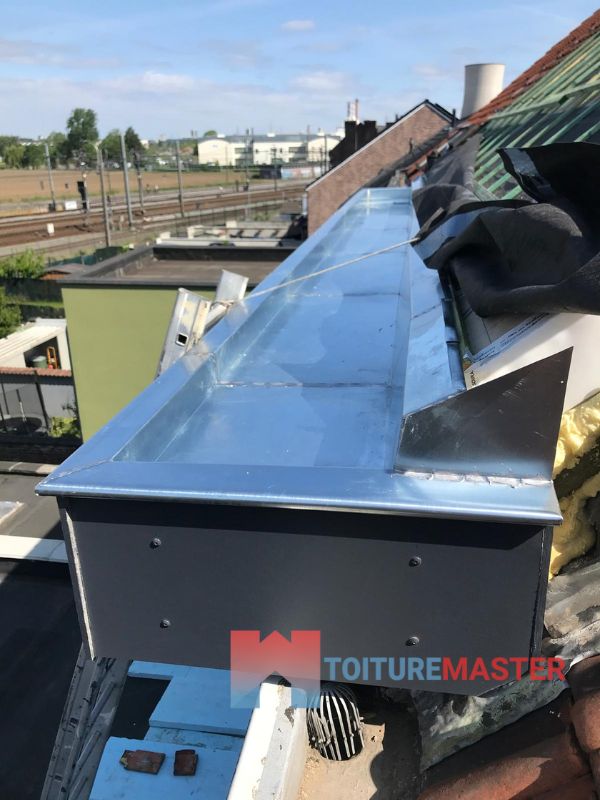
Zinc requires skilled installation. It’s worked by hand-forming, seaming, and fixing — not panel-clipping. Toiture Master’s team includes experienced zinc workers (zingueurs) who handle this correctly. Poor zinc installation — incorrect expansion joints, inadequate fixings, improper seam formation — is the primary cause of zinc facade failure. The material itself almost never fails.
Composite Cladding in Brussels: The Low-Maintenance Middle Ground
Composite cladding is made from a blend of materials — typically wood fibre or rice husk combined with a polymer (PVC, polyethylene, or polypropylene). The result is a material that looks like wood, behaves more predictably than wood in wet climates, and requires far less maintenance.
It’s genuinely useful for specific Brussels applications. It’s not the most architecturally ambitious material, and it won’t age into anything beautiful the way zinc or real wood does. But for homeowners who want a clean, practical exterior solution with a realistic maintenance commitment of approximately zero, composite has a solid case.
How composite performs in Belgian conditions:
Composite doesn’t absorb water the way wood does. It doesn’t swell, warp, or crack with seasonal moisture changes. It won’t develop the green biological growth that affects untreated timber in Belgium’s damp climate. For north-facing or heavily shaded walls — where natural wood struggles — composite is more consistently reliable.
The Belgian climate’s freeze-thaw cycling, which is particularly hard on porous materials, has minimal effect on composite. It’s dimensionally stable across the temperature and moisture range Brussels experiences. That’s a genuine technical advantage for a city that gets rain in every month of the year.
Lifespan:
Good quality composite cladding — from established brands rather than budget imports — typically lasts 25–30 years in Belgian exterior conditions. Mid-range quality products may show UV fading, surface crazing, or colour inconsistency after 10–15 years. The quality differential is significant: specify reputable brands and don’t make the purchase decision on material cost per m² alone.
Maintenance:
Annual cleaning with a pressure washer or brush is the standard recommendation. No oiling, no staining, no treatment programme. For time-poor homeowners or rental property owners where maintenance reliability matters, this is composite’s strongest selling point.
Aesthetics:
Composite cladding has improved significantly in visual quality over the past decade. The best products convincingly replicate wood grain texture and offer a wide colour palette that goes well beyond the wood-brown range. However, it doesn’t develop the character over time that zinc patina provides, and the wood-look versions will never quite fool someone who knows real timber.
For contemporary applications — particularly commercial ground floors, modern extensions, or properties where a clean, uniform appearance is specifically desired — composite works well aesthetically. For traditional Brussels street facades and heritage-adjacent properties, it’s a harder sell.
Cost of composite cladding in Brussels:
Material: €30–€80 per m² depending on quality and brand. Installed: €60–€120 per m² including cavity system and fixings. Total project cost: for a typical Brussels facade panel, expect €2,000–€8,000 depending on area. Maintenance cost per year: minimal (occasional cleaning only).
Cost Breakdown: What Exterior Cladding Actually Costs in Brussels in 2026
Here are realistic installed cost ranges for a Brussels exterior cladding project in 2026, based on Belgian market pricing.
Important context:
All figures below are installed costs — material, labour, ventilated cavity system (battens, membrane, fixings), and waste removal. They assume a standard residential façade with straightforward geometry. Complex shapes, multiple openings, high-access requirements (scaffolding), or integration with external insulation will increase costs.
Natural hardwood cladding:
- Material: €40–€65 per m²
- Installation (including cavity): €25–€45 per m²
- Total: €65–€110 per m²
- Project example (30 m² side extension): €1,950–€3,300
Thermowood cladding:
- Material: €35–€45 per m²
- Installation (including cavity): €25–€40 per m²
- Total: €60–€85 per m²
- Project example (30 m² side extension): €1,800–€2,550
Zinc cladding (standard titanium zinc):
- Material: €80–€150 per m²
- Installation by experienced zingueur: €70–€100 per m²
- Total: €150–€250 per m²
- Project example (30 m² side extension): €4,500–€7,500
Composite cladding (mid-range quality):
- Material: €35–€60 per m²
- Installation (including cavity): €25–€40 per m²
- Total: €60–€100 per m²
- Project example (30 m² side extension): €1,800–€3,000
Scaffolding:
Add €500–€1,500 for most Brussels terraced house projects. Required for safe access to all but ground-floor panels.
Whole-life cost comparison (30 m² project over 30 years):
Over 30 years, composite and Thermowood are comparable in whole-life cost. Zinc is significantly more expensive upfront but has zero maintenance cost — and at year 30, zinc is at approximately 20–30% of its total lifespan. Thermowood and composite will need full replacement within that same period.
Which Cladding Type Is Right for Your Brussels Property?
Use this as a decision framework rather than a rigid prescription — your roofer will advise specifically after seeing your property.
Choose zinc if:
- Your property is a traditional Brussels terraced house or semi-detached in Koekelberg, Laeken, Molenbeek, or Schaerbeek — zinc sits naturally in these architectural contexts
- You’re cladding a flat-roofed section and want the roof covering and facade to be the same material
- You want the lowest possible long-term maintenance commitment
- You’re planning to stay in the property long-term and want a 100-year solution
- You appreciate the evolving patina aesthetic and understand that zinc looks better at 20 years than at installation
Choose Thermowood if:
- Your property is a contemporary design or modern extension where the warm tones of wood feel architecturally appropriate
- You want the natural authenticity of real wood but can’t justify hardwood costs
- You’re comfortable with a maintenance cycle of oiling every 4–5 years
- Environmental credentials matter — Thermowood is chemical-free and from certified, managed forests
- You’re working on a garden studio, rear extension, or new-build element in a Brussels garden
Choose composite if:
- You’re cladding a commercial ground floor, rental property, or any application where near-zero maintenance is essential
- You have a specific colour in mind that neither wood nor zinc can naturally provide
- The property is a postwar or modern building where the material language is already non-traditional
- Budget is the primary constraint and the 25–30 year lifespan matches your ownership horizon
- You’re cladding a north-facing or permanently shaded wall where natural wood would be at a disadvantage
Think carefully before choosing:
- Natural untreated softwood on any Brussels exterior — the maintenance demands in this climate are not manageable for most homeowners
- Budget composite products without confirmed technical datasheets — the quality range in composite is enormous and the failures are ugly
- Any cladding material on a heritage-sensitive street without checking planning requirements first
Planning Permission for Cladding in Brussels: What You Need to Know
This is the section that catches many Brussels homeowners by surprise. Unlike the UK, where permitted development rights cover most modest cladding changes, Belgian planning rules require closer attention.
The general rule:
Any change to the external appearance of a building in Brussels may require a planning permit (permis d’urbanisme) from your commune. This applies to cladding installation — even when you’re covering an existing surface rather than changing the wall structure.
When you’re more likely to need a permit:
- Properties on a street in a protected zone (zone de protection)
- Listed buildings or buildings in the immediate vicinity of listed buildings
- Any cladding that significantly changes the material character of the façade
- Zinc or metal cladding on a traditional street where brick or render is the dominant material
When you may not need a permit:
- Cladding of a rear extension not visible from the public realm
- Like-for-like material replacement on a non-protected façade
- Some communes have simplified procedures for minor works — always check with your commune directly
The practical step:
Before any cladding project in Brussels, contact your commune’s urban planning department (urbanisme) and describe the proposed work. You can also use the Brussels planning portal (urban.brussels) to check the zone classification for your property. Toiture Master can advise based on their experience across all 19 Brussels communes — they’ll flag projects where planning engagement is advisable before work begins.
How Toiture Master Installs Cladding in Brussels
Toiture Master’s cladding service covers all three material types discussed in this guide. Their base in Koekelberg puts them at the heart of Brussels, with experience across all 19 communes from Watermael-Boitsfort in the south to Ganshoren and Laeken in the north.
Here’s exactly what their process looks like for a cladding project.
Free site visit — always the starting point
Every cladding project begins with a free visit to your property. Toiture Master’s team assesses the existing wall construction, identifies any moisture or structural issues that need addressing before cladding is applied, measures the facade, and discusses material options with you in the context of your specific building and street.
This visit is free, takes approximately 30–60 minutes, and comes with no obligation. You’ll leave with an honest opinion on which material is most appropriate and why — not just the one with the highest margin.
Substrate preparation — the step most contractors skip
The most important part of a cladding project happens before a single panel goes up. The existing wall surface must be correctly prepared: moisture issues resolved, damaged render or brick stabilised, and the ventilation cavity batten system installed correctly. A ventilated cavity is non-negotiable for all three cladding materials — without it, moisture trapped between the cladding and the wall causes exactly the damp problems you were trying to prevent.
Toiture Master installs the cavity batten system with proper horizontal and vertical ventilation, a breather membrane appropriate to the chosen cladding material, and correctly specified fixings for the wall construction type (solid brick, concrete block, cavity wall).
Material installation — skilled hands for every material
For zinc: Toiture Master’s team includes experienced zinc workers. Zinc cladding is formed, seamed, and fixed by hand — it’s a craft skill, not a panel-clicking exercise. Expansion joints are correctly calculated for the panel dimensions and climate exposure. Seams are formed correctly and consistently. The result is a zinc facade that won’t lift, bubble, or leak at the seams — the failure modes of poorly installed zinc work.
For Thermowood: boards are installed with correct expansion gaps, appropriate stainless steel fixings (which won’t bleed rust onto the wood surface), and consistent profile alignment. End grain is correctly protected. The ventilation cavity is maintained correctly at head and sill to allow moisture to drain and air to circulate.
For composite: panel systems are installed according to the manufacturer’s specification — which varies by brand. Correct fixing centres are maintained, expansion gaps are included, and cut edges are finished cleanly.
Integration with roofing elements
One of the specific advantages of using Toiture Master for cladding is their roofing expertise. In many Brussels projects, new cladding meets roofing elements — a flat roof edge, a parapet, zinc gutters or downpipes. Toiture Master handles the junction between cladding and roofing in-house, ensuring weathertight continuity without the coordination failures that come from using separate cladding and roofing contractors.
Documentation and guarantee
Every cladding project includes a written workmanship guarantee. Toiture Master provides documentation of the materials used, the installation method, and the specification — useful for future property sales, insurance purposes, or planning applications.
📍 Avenue du Panthéon 88, 1081 Koekelberg 📞 +32 493 47 14 49 | 📧 info@toituremaster.be 🌐 toituremaster.be/bardages/
Cladding and Energy Performance: The Insulation Connection
Exterior cladding and wall insulation are distinct projects — but they’re most efficiently done together. If you’re going to the trouble and cost of installing a new cladding system on your Brussels home, the decision to include external wall insulation at the same time adds relatively little incremental labour cost and can transform your home’s energy performance.
External wall insulation (EWI) involves fitting rigid insulation boards to the existing wall surface before the cladding and cavity system are applied. For a solid brick Brussels terraced house — which has no cavity to fill with blown insulation — EWI is often the only practical route to meaningful wall insulation.
The thermal benefit is significant. A solid brick wall in a Brussels terrace typically has a U-value of around 1.8–2.0 W/m²K — well above the Brussels building regulation target. Adding 100mm of mineral wool insulation behind a ventilated cladding system can bring this below 0.3 W/m²K — a sixfold improvement in thermal performance.
Combined with the roof insulation that addresses the 30% heat loss from above, external wall cladding with insulation can fundamentally change the comfort and energy cost of an older Brussels home.
Once RENOLUTION grants reopen, external wall insulation combined with cladding may qualify for grant support — particularly for lower-income households. Toiture Master will advise on the technical specification required for grant eligibility and ensure the project is documented correctly.
FAQ: Exterior Cladding in Brussels Answered
What is exterior cladding and why would I install it on my Brussels home?
Exterior cladding is a protective and decorative layer applied to the external walls of a building. It protects the structure from rain, UV radiation, and temperature cycling while improving the home’s appearance and — when combined with external wall insulation — its energy performance. In Brussels, cladding is commonly used to replace deteriorating render or brick surfaces, to modernise older properties, or to clad new extensions in a material that contrasts with or complements the existing building.
Which is the best cladding material for Brussels homes — wood, zinc, or composite?
There’s no single best material — it depends on your property and priorities. Zinc is the native Belgian material with the longest lifespan (80–150 years) and lowest maintenance, and it integrates naturally with Brussels’s existing architectural material palette. Thermowood offers a natural aesthetic with better climate performance than conventional wood and low maintenance. Composite is the most practical for landlords and low-maintenance-focused homeowners, with a 25–30 year lifespan. A free site visit from Toiture Master will clarify which option makes most sense for your specific property.
How much does exterior cladding cost in Brussels in 2026?
Installed costs range from approximately €60–€85 per m² for Thermowood, €60–€100 per m² for composite, €65–€110 per m² for natural hardwood, and €150–€250 per m² for zinc. For a typical 30 m² Brussels extension or facade panel, total project costs range from €1,800 (basic composite) to €7,500 (zinc). Scaffolding adds €500–€1,500 for most Brussels terrace projects. All qualifying work on homes over 10 years old benefits from the 6% VAT rate rather than the standard 21%.
Do I need planning permission for exterior cladding in Brussels?
Possibly — and it’s important to check before starting work. Any change to the external appearance of a Brussels property may require a permis d’urbanisme from your commune, particularly if the property is in a protected zone or near a listed building. The safest approach is to contact your commune’s urbanisme department before commissioning any cladding work. Toiture Master can advise based on their experience across all 19 Brussels communes.
How long does zinc cladding last in Brussels?
Zinc facade cladding has a life expectancy of 80 to 150+ years in Brussels’s urban environment. High-purity titanium zinc alloys — the standard for quality architectural zinc work — can last even longer. The self-healing zinc carbonate patina that forms on the surface continually protects and repairs the material. Zinc requires no painting, sealing, or chemical treatment throughout its life. It’s the material of choice for homeowners who want to fit cladding once and never revisit the decision.
Can cladding improve my Brussels home's energy performance?
Yes — significantly, when combined with external wall insulation. A ventilated cladding system on a Brussels terrace installed with 100mm of mineral wool insulation can reduce wall U-values from approximately 2.0 W/m²K to below 0.3 W/m²K — transforming the wall from one of the home’s worst thermal elements to one of its best. This is most impactful on solid brick Brussels terraced houses where cavity wall insulation isn’t possible. When RENOLUTION grants reopen, external wall insulation projects may qualify for grant support.
What maintenance does wood cladding require in Belgium?
Natural hardwood cladding in Belgium’s climate requires re-treatment with a UV-stable exterior oil or pigmented stain every 3–4 years to maintain its colour and protect against biological growth. Without treatment, hardwood will grey (naturally but acceptably) and eventually crack over time. Thermowood requires much less frequent maintenance — optional oiling every 4–5 years will maintain the original colour, but left untreated, it silvers gracefully to a natural grey without structural deterioration. Composite requires only annual cleaning with water — no oil, stain, or treatment programme.
If you’re considering exterior cladding for your Brussels home, Toiture Master offers a completely free site visit and written quote — no obligation, no pressure. They’ll assess your property, advise honestly on material options, and give you a clear, itemised price. Contact them across all 19 Brussels communes.
📞 +32 493 47 14 49 | 📧 info@toituremaster.be | 🌐 toituremaster.be/bardages/