
Introduction
Every autumn, Brussels roofers get the same wave of calls. The heating goes on for the first time since spring. And suddenly homeowners notice a damp patch on the ceiling near the chimney breast, a brownish stain spreading across the top-floor wall, or water pooling at the base of the fireplace.
Chimney leaks in Brussels are one of the most common — and most misdiagnosed — roofing problems in the city. They’re not always dramatic. They rarely announce themselves with a sudden flood. Instead they show up quietly: a musty smell in a bedroom, a strip of peeling wallpaper, a ceiling that never quite dries out. By the time most homeowners call a professional, the water has already been coming in for months.
The frustrating part? Most chimney leaks are completely preventable. The structure of a Brussels chimney — the cap, the mortar joints, the flashing, the flue lining — degrades gradually and predictably. An experienced roofer who knows what to look for can catch and fix problems in an hour that, left unattended, would cost thousands to repair a year later.
That’s what this guide is about. We’ll walk you through every component of a Brussels chimney that your roofer should inspect every autumn, why each one matters, what signs of failure look like, and what the repair involves. We’ll also cover costs, the relationship between chimneys and Belgian insurance claims, and how Toiture Master handles chimney work across all 19 Brussels communes.
📞 +32 493 47 14 49 | 🌐 toituremaster.be/cheminees/
Table of Contents
- Why Autumn Is the Critical Season for Brussels Chimneys
- The 7 Things Your Roofer Must Check on a Brussels Chimney
- Check 1 — The Chimney Cap and Crown
- Check 2 — The Flashing
- Check 3 — The Mortar Joints and Brickwork
- Check 4 — The Chimney Pot
- Check 5 — The Flue Lining
- Check 6 — The Chimney Stack Structure
- Check 7 — The Surrounding Roof Tiles
- Chimney Leaks and Belgian Insurance: What You Need to Know
- How Toiture Master Handles Chimney Work in Brussels
- Signs You Already Have a Chimney Leak Inside Your Home
- FAQ: Chimney Leaks in Brussels Answered
Why Autumn Is the Critical Season for Brussels Chimneys
Brussels has a particular climate problem for chimneys.
The city gets significant rainfall throughout the year — around 800mm annually — but autumn brings a specific combination that stresses chimney structures harder than any other season. You get heavy rain and wind from Atlantic depressions. Then freezing overnight temperatures that cause water trapped in porous masonry to expand, widening cracks. Then a sudden return to mild and wet. This freeze-thaw cycle is one of the most destructive forces a brick-and-mortar chimney faces, and it happens repeatedly every October through December.
Add to this the fact that most Brussels chimneys sit dormant from April to October. During those six months, mortar dries out, sealants shrink, and thermal expansion during summer heat can open hairline cracks that were invisible in spring. The first autumn rain then finds paths it didn’t have last year.
And then comes the heating. Brussels firefighters respond to chimney fires more than once a week on average, according to Energuide’s data — because homeowners turn on a neglected system without checking whether it’s safe. The chimney that was fine last January might have developed a cracked flue lining, a blocked pot, or a missing section of cap over summer. None of these announce themselves until the fire is lit.
The combination of Belgian autumn weather, summer dormancy, and the return to active use makes September and October the perfect window for a professional chimney inspection. Not after the first leak appears. Before.
The 7 Things Your Roofer Must Check on a Brussels Chimney
A proper autumn chimney inspection covers seven distinct components. Each can fail independently. Each can be the source of a leak that’s blamed on something else — a cracked tile, a plumbing pipe, condensation — because water travels unpredictably through a house’s structure.
Here’s exactly what Toiture Master checks on every Brussels chimney inspection, and why each point matters.
Check 1 — The Chimney Cap and Crown
The chimney cap — called a chapeau de cheminée in French — is the concrete or mortar element that sits at the very top of the chimney stack, over the brickwork. Its job is to shed rainwater away from the flue opening and the top course of bricks.
The chimney crown is the sloped concrete or mortar surface around the base of the chimney pot. Think of it as a collar — it seals the junction between the pot and the brickwork and directs water off the top of the stack.
Both are exposed to everything Brussels weather throws at them. In older homes across Koekelberg, Molenbeek, and Etterbeek — where chimney structures haven’t been touched in decades — it’s common to find crowns with deep cracks, missing sections, or the entire cap loose and shifted.
What failure looks like: Cracks in the crown surface, often running in a Y or star pattern. Crumbling concrete at the edges. A chimney cap that rocks slightly when pushed. Efflorescence (white salt deposits) on the top brickwork, which indicates water has been entering and evaporating.
What the repair involves: Minor cracks in the crown can be sealed with a flexible, weatherproof masonry sealant. Larger cracks or a crown that’s structurally compromised needs to be broken off and rebuilt in lime-based mortar. A missing or cracked cap is replaced entirely — stainless steel or terracotta caps are the most durable options for Brussels’s climate.
Cost range: Cap replacement: €150–€400 depending on chimney height and access. Crown repair: €200–€600. Full crown rebuild: €400–€1,000.
Why it matters first: The crown and cap are the chimney’s primary defence. If water gets past them, it saturates the brickwork, accelerates mortar decay, and works its way down into the flashing and the interior. Fixing the crown costs a fraction of what it costs to fix the cascade of damage that follows when you don’t.
Check 2 — The Flashing
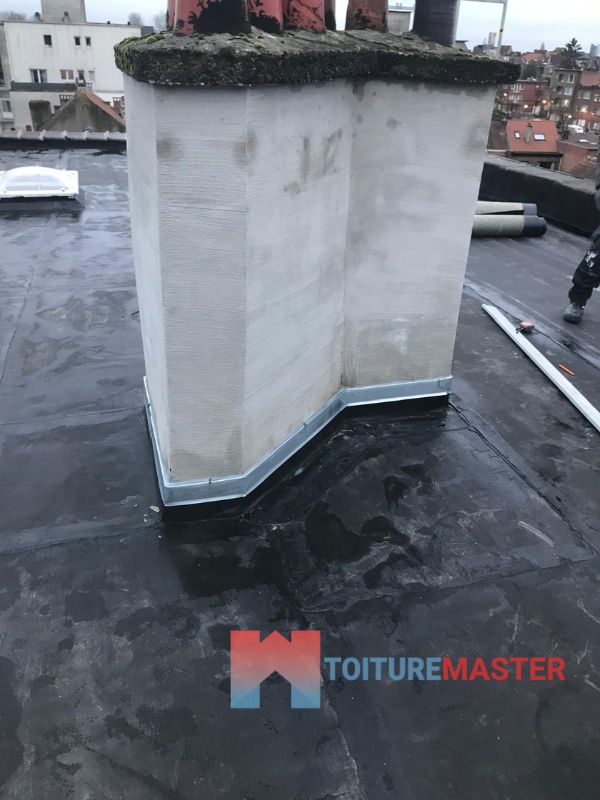
Flashing is the metal — usually zinc, lead, or aluminium — that seals the joint where your chimney meets your roof surface. It’s the most critical waterproofing element of any chimney, and the most common source of chimney leaks in Brussels.
The chimney sits as a vertical structure passing through the roof plane. Where those two elements meet, you have a junction between masonry (which expands and contracts with temperature) and roofing tiles or slates (which move slightly with the roof structure). Metal flashing bridges this gap. When it works, it’s invisible and watertight. When it fails, water runs directly into the roof structure at one of the most vulnerable points of the entire building.
Flashing typically consists of two elements: the step flashing (which runs in steps between the chimney and the tiles on the sides) and the back flashing or saddle (which diverts water coming from above the chimney around the sides rather than letting it pool behind the stack).
In many older Brussels homes — particularly the terraced houses of Schaerbeek, Anderlecht, and Forest that were built in the early to mid 20th century — the original flashing was installed in lead. Lead lasts 50–100 years but eventually fatigues and cracks at stress points. Repairs over the years sometimes replace lead with cheaper aluminium or bitumen tape, which degrades far more quickly.
What failure looks like: Visible gaps between the flashing and chimney face. Flashing that’s pulled away from the mortar joint. Rust staining on the tiles below the chimney. Bitumen tape repairs that have cracked or peeled. No visible back flashing behind the chimney stack — a common omission on older Brussels roofs.
What the repair involves: Loose or partially failed flashing can sometimes be re-fixed and re-sealed with appropriate flashing sealant. But where the flashing has corroded, cracked, or pulled away significantly, the correct repair is replacement — removing the old material, re-cutting and fitting new zinc or lead flashing, and tucking it properly into mortar joints on the chimney face. Toiture Master uses zinc for all flashing replacements, which matches the existing zinc guttering and zinguerie typical across Brussels roof systems.
Cost range: Flashing repair (partial re-sealing): €200–€500. Full flashing replacement: €500–€1,500 depending on chimney size and access. This is the single most cost-effective chimney repair you can make — because failing flashing causes water damage to roof timbers, insulation, plasterwork, and ceilings that costs many times more to remediate.
Check 3 — The Mortar Joints and Brickwork
The mortar between your chimney’s bricks does two jobs: it holds the bricks together, and it provides a waterproof (or water-resistant) layer on the chimney’s exterior face. When mortar fails, bricks loosen, and water infiltrates the stack.
In Brussels, most chimney stacks are made from fired clay brick — excellent structural material, but porous. The mortar that was used in early and mid-century construction was typically lime-based, which is relatively soft and gradually erodes when exposed to weathering. By the time a Brussels chimney is 50 years old, the mortar joints may have receded by 10–20mm from the brick face, creating tiny open channels that collect and conduct rainwater.
This process is called repointing when it’s repaired — the old mortar is raked out and new mortar is applied. But there’s a critical subtlety that not all contractors know: the replacement mortar must be softer than the brick. If a harder cement mortar is used — as is common with unskilled repairs — it doesn’t flex with the chimney’s thermal movement. Cracks develop at the brick-mortar interface, which are actually harder to seal and more damaging than the original soft-mortar erosion.
What failure looks like: Visible gaps between brick courses where the mortar has receded. Loose or missing individual bricks. Bricks that have started to spall (flake and crumble on their surface) — a sign that water has been freezing inside them. A white chalky deposit (efflorescence) on the chimney face.
What the repair involves: Raking out the old mortar to a depth of 15–20mm. Cleaning the joint. Applying new lime-based mortar matched to the original specification. For spalled bricks, individual bricks may need replacing. For severely deteriorated chimneys, full repointing of the entire stack is necessary.
Cost range: Partial repointing (one or two faces): €300–€800. Full chimney repointing: €600–€2,000 depending on height and extent of deterioration. Spalled brick replacement: add €50–€150 per brick including matching and pointing. These costs scale significantly with scaffolding requirements — a chimney that can’t be safely reached from a ladder requires a proper scaffold platform, adding €300–€600 to any external chimney repair.
Check 4 — The Chimney Pot
The chimney pot — the ceramic or terracotta cylinder that extends above the crown — controls the draught that pulls smoke and combustion gases up and out of the flue. Without a pot, or with a damaged one, rain falls directly into the flue opening. With a blocked pot — from a bird’s nest, dead leaves, or a fallen section of masonry — gases can’t escape efficiently and may be pushed back into the home.
Brussels has an enormous variety of chimney pot types, from original Victorian-era terracotta in older communes to more modern concrete pots in postwar buildings. Original terracotta pots are beautiful but brittle — a heavy hailstorm or a falling tile can crack them without any obvious external sign.
Energuide notes that Brussels firefighters are called out to chimney fires more than once a week. A significant proportion of these are caused by blocked flues — nesting material from jackdaws and pigeons (both common in Brussels) accumulating over summer and igniting when the fire is lit in autumn.
What the roofer checks: The physical condition of the pot — cracks, chips, or a pot that’s shifted from its mortar bed. The presence of a pot guard or bird guard over the opening, particularly important for chimneys that are no longer in active use. Clearance inside the pot from above — any blockage from nesting material or debris.
What failure looks like: A visibly cracked or tilted pot. No bird guard on an unused chimney. Black staining around the pot opening from previous combustion backdraft. Twigs or nesting material visible at the top of the flue.
What the repair involves: A cracked pot is replaced — terracotta or stainless steel pots are the standard in Brussels. A blocked flue is cleared from above using a specialist brush and extraction equipment. A bird guard or chimney cowl is fitted where appropriate.
Cost range: Pot replacement €100–€350 per pot. Bird guard fitting: €80–€150. Flue clearance (if blocked): €150–€300. These are among the lowest-cost chimney repairs available — and among the highest consequence if left undone.
Check 5 — The Flue Lining
The flue lining is the interior surface of the chimney shaft — the channel through which combustion gases travel from the fire to the outside. In older Brussels homes, many chimney flues are unlined — just bare brickwork. In more modern or renovated properties, the flue may have a stainless steel liner or a ceramic liner installed.
The flue lining matters for two reasons: waterproofing and safety. An unlined flue allows condensation from combustion gases to saturate the surrounding brickwork. Over years, this causes the mortar to deteriorate from the inside — invisible on the outside until damage is already severe. And if the flue is used for combustion, a cracked or absent lining allows heat and combustion gases — including carbon monoxide — to seep into surrounding rooms.
What the roofer checks: For visual inspection from below, a torch and mirror can reveal obvious cracking, collapse, or blockage. For a definitive assessment of liner condition, a CCTV camera inspection is the gold standard — a small camera is passed down the flue on a cable, and the entire shaft is inspected on a monitor. Toiture Master can advise on whether a full CCTV inspection is warranted based on the chimney’s age, history, and visible condition.
What failure looks like: Visible cracks in the flue interior. White efflorescence on the chimney breast interior plasterwork — this often means moisture has been travelling through the flue brickwork. A flue that has never been lined in a property over 40 years old.
What the repair involves: For unlined flues that will remain in active use: installation of a flexible stainless steel liner, pushed through from the chimney top down to the appliance connection point. For flues that will no longer be used: installation of a proper chimney cowl and ventilation cap to prevent rainwater entry while maintaining airflow.
Cost range: Flexible stainless steel flue liner installation: €800–€2,500 depending on chimney height and flue diameter. CCTV inspection: €150–€300. Cowl and cap for redundant flue: €150–€400.
Check 6 — The Chimney Stack Structure
The chimney stack is the entire above-roof section of the chimney — from the roof line to the top of the pot. In most Brussels terraced houses, the stack extends 1–2 metres above the roof surface. In larger or older properties in Ixelles or Uccle, stacks can extend 3 metres or more.
A chimney stack must be structurally stable. It carries significant weight, is exposed to wind loading, and is attached to the rest of the building only at the roof line. A stack that has developed a lean — even a slight one — is a structural concern. A leaning or unstable stack that fails in a winter storm can cause catastrophic damage to the roof, and potentially to people or property below.
What the roofer checks: Visual inspection of the stack from roof level for visible lean or displacement. Checking the mortar at the base of the stack — where it meets the roof structure — for cracking or movement. Looking for gaps between the stack and surrounding tiles that indicate settlement.
What failure looks like: A stack that’s visibly out of plumb when viewed from the ground. Horizontal cracking in the brickwork — this suggests differential settlement or structural movement. A base that’s pulling away from the surrounding roof surface.
What the repair involves: Minor lean with stable mortar is monitored rather than immediately repaired. Significant lean requires a structural assessment. A severely unstable stack may need to be taken down and rebuilt — expensive, but far less so than the damage caused by an uncontrolled collapse.
Cost range: Structural assessment: €200–€400. Partial rebuild of upper stack: €800–€3,000. Full stack rebuild: €2,000–€8,000 depending on height and complexity
Chimney Leaks and Belgian Insurance: What You Need to Know
Chimney leaks and their relationship with Belgian insurance policies is a topic that catches many Brussels homeowners off guard. Here’s what you need to understand before you experience a problem.
Storm damage is usually covered — neglect is not.
If your flashing is ripped away by a winter storm, or a chimney pot is knocked off by a falling tree, your home insurance policy will typically cover the repair. Storm and sudden weather events are insurable risks.
What isn’t covered is gradual decay from lack of maintenance. If your insurance assessor establishes that the flashing had been failing for years, that the mortar joints were visibly deteriorated, and that no professional inspection had been carried out — your claim can be reduced or refused.
An unmaintained chimney can invalidate a claim.
Energuide’s guidance on chimney maintenance is clear: if you use a chimney for combustion and haven’t had it swept and inspected by a qualified professional, your insurance company may decline to cover a chimney fire. The chimney sweep or inspector provides a certificate proving maintenance was carried out — and that certificate is your evidence in a claim.
Insurance-approved contractors matter.
Toiture Master is approved by Belgian insurance companies — one of the trust signals highlighted throughout their work. When they inspect and repair a chimney, the documentation they provide carries weight with insurers. If damage is found and repaired, you have a professional record of the condition and the remediation. That record protects you in any future claim.
For homeowners in Brussels who use their chimneys — for wood-burning stoves, pellet inserts, or gas appliances — the combination of an annual chimney sweep and an annual roofer’s inspection of the external chimney components is the minimum maintenance standard that keeps you insured.
How Toiture Master Handles Chimney Work in Brussels
Toiture Master’s chimney service — accessible at toituremaster.be/cheminees/ — covers every aspect of chimney work that falls under a roofer’s expertise. That means the exterior components: the cap, the crown, the flashing, the pot, the stack, and the surrounding tiles.
Here’s what their process looks like.
Free site visit — the starting point for every job
Every chimney inspection starts with a free visit. A Toiture Master professional comes to your home, accesses the roof, and carries out a systematic check of all seven components covered in this guide. This isn’t a two-minute glance from the garden. It’s a proper inspection from roof level.
You receive a verbal summary on the day and a written quote for any work recommended — itemised, clear, and with no hidden extras. No pressure to proceed.
Transparent recommendations — what needs doing now vs what to monitor
Not every chimney issue needs immediate repair. Some conditions — minor hairline cracks in the crown, slight mortar recession on a chimney that’s not actively used — can be monitored rather than treated urgently. Toiture Master’s approach is honest: they’ll tell you what’s genuinely urgent, what can wait, and what should be checked again at the next inspection.
The right materials for Brussels chimneys
Toiture Master uses lime-based mortars for repointing older Brussels chimney stacks — matching the original specification rather than applying rigid cement that will fail prematurely. For flashing replacement, they use zinc — the material that matches the zinc gutters and downpipes that are standard across Brussels roof systems. Caps and pots are sourced from established Belgian roofing material suppliers.
Insurance-ready documentation
After every chimney repair, Toiture Master provides documentation suitable for your insurer: a description of the work carried out, the materials used, and photos of the completed repair. If you need to make a claim relating to chimney damage in future, this documentation is your evidence of proper maintenance.
Serving all 19 Brussels communes
Toiture Master operates from Koekelberg and covers every commune in the Brussels-Capital Region: Ixelles, Uccle, Anderlecht, Schaerbeek, Molenbeek, Jette, Ganshoren, Etterbeek, Forest, Laeken, Berchem-Sainte-Agathe, Evere, Saint-Gilles, Saint-Josse, Woluwe-Saint-Lambert, Woluwe-Saint-Pierre, Watermael-Boitsfort, Auderghem, and Koekelberg itself.
For emergency roofing situations — a chimney pot lost in a storm, active water infiltration overnight — they offer rapid response intervention.
📍 Avenue du Panthéon 88, 1081 Koekelberg 📞 +32 493 47 14 49 | 📧 info@toituremaster.be
Signs You Already Have a Chimney Leak Inside Your Home
Sometimes the autumn inspection catches the problem before it reaches the interior. Sometimes it’s already there. Here are the signs that a chimney leak has been working its way into your Brussels home.
Damp or water stains on the ceiling near the chimney breast. The most obvious sign. A brownish ring or expanding stain on the ceiling adjacent to the chimney stack almost always points to water coming in at or above roof level. Note: the stain may appear several feet from the chimney if water has tracked along a joist or rafter.
Peeling wallpaper or bubbling paint on the chimney breast wall. Moisture migrating through the chimney brickwork pushes outward through internal walls. Wallpaper peels from the corners of the chimney breast before the centre. Paint bubbles and eventually flakes.
A persistent musty smell in a room with a chimney. Damp brickwork has a distinctive earthy smell that intensifies in autumn when the heating comes on. If you notice it specifically in rooms with fireplaces — even unused ones — it warrants a chimney inspection.
White chalky deposits (efflorescence) on the chimney breast interior. This white crystalline deposit forms when water carrying mineral salts evaporates from masonry. It’s a reliable indicator that water has been moving through the brickwork.
Water or moisture inside the fireplace or at the base of the flue. Particularly after heavy rain. This can indicate a failed cap, a cracked crown, a blocked or absent pot, or flashing failure — sometimes a combination.
Soot staining or a smoky smell in rooms when the fire isn’t lit. This suggests a blockage or flue lining problem that’s allowing wind to push gases back down from the chimney into the room. It’s also a safety concern that warrants immediate professional assessment.
Damp patches on upstairs walls near an external chimney stack. Particularly on the wall closest to the chimney’s exterior face. If the brickwork is saturated, it conducts moisture to internal surfaces even without a direct water path.
If you’re seeing any two of these signs together, don’t wait for the next inspection cycle. Call Toiture Master directly — the damage only gets more expensive with time.
FAQ: Chimney Leaks in Brussels Answered
What causes chimney leaks in Brussels?
Chimney leaks in Brussels are most commonly caused by one or more of the following: failed or missing flashing at the junction of the chimney and roof; a cracked or damaged chimney cap or crown; eroded mortar joints in the brickwork; a cracked, displaced, or absent chimney pot; condensation inside an unlined flue; or water penetrating directly through saturated brickwork. Brussels’s freeze-thaw autumn climate and the city’s ageing housing stock make all of these issues more common than in newer or drier climates.
How much does chimney repair cost in Brussels?
Chimney repair costs in Brussels range from around €150 for a simple cap replacement to €2,000 or more for a full stack repointing or flue lining installation. The most common repair found during an autumn inspection — flashing repair or replacement — typically costs between €200 and €1,500 depending on the extent of failure and whether scaffolding is required. A free inspection from Toiture Master will identify exactly what needs doing and at what cost, with no obligation.
How often should I have my chimney inspected in Brussels?
You should have your chimney inspected by a professional roofer at least once a year — ideally every autumn before the heating season begins. If your chimney is used for combustion (wood stove, open fire, gas appliance), you should also have it swept by a certified chimney sweep annually. Energuide notes that a third of house fires in Brussels start in a chimney or flue — annual inspection and maintenance is the most reliable way to prevent this.
Can chimney leaks damage my roof structure?
Yes — significantly. Water entering through a failed chimney cap, cracked flashing, or eroded mortar doesn’t stay in the chimney. It tracks along timber rafters, saturates insulation, and eventually reaches plasterboard ceilings and internal walls. In the worst cases, prolonged chimney water infiltration causes timber rot in the roof structure, requiring expensive structural repairs. Catching and fixing a chimney leak early — while it’s still a €300 mortar or flashing repair — is far less costly than dealing with the consequences after a season of water infiltration.
Does Belgian home insurance cover chimney leak repairs?
It depends on the cause. Storm damage to a chimney — a pot blown off, flashing ripped away, a tile cracked by falling debris — is typically covered by Belgian home insurance. Gradual deterioration from lack of maintenance is not. An insurer may decline or reduce a claim if there’s evidence that the chimney wasn’t properly maintained — which is why professional inspection records matter. Toiture Master is approved by Belgian insurance companies, and the documentation they provide after any chimney repair or inspection supports your position in any future claim.
Is a chimney that's no longer in use still a leaking risk?
Absolutely. A dormant chimney — one that’s been blocked off at the fireplace and is no longer used for combustion — still presents a significant water risk if the exterior components aren’t maintained. The cap, crown, flashing, and pot all continue to degrade regardless of whether the chimney is in use. A blocked-up fireplace can mask the signs of water infiltration for months, allowing serious damage to accumulate unseen. For unused chimneys, Toiture Master recommends fitting a proper chimney cowl with a ventilation cap to prevent water entry while maintaining airflow through the stack.
If you’ve noticed any of the warning signs in this guide — or simply haven’t had your chimney checked this year — Toiture Master offers a completely free site visit and written quote for chimney inspections across all 19 Brussels communes. No obligation. No pressure. Just an honest assessment before winter arrives.
📞 +32 493 47 14 49 | 📧 info@toituremaster.be | 🌐 toituremaster.be/cheminees/